I was searching today to update some images in one of my PowerPoints for RRW, when I stumbled across a remarkable find that I just have to share with you! I had been thinking about how much some medicine looks like candy and we had talked about this idea quite a bit in several of my classes. I was also thinking how awesome it would be if I could create a game where students had to guess which was the medicine and which was the candy. Well, someone has done that and shared it on-line! No need to re-invent that wheel! I have taken the link I found while searching Google images and hyperlinked it in a simple PowerPoint that you can use with your classes. There are 3 levels of play and it asks you to guess on each screen which item is candy or medicine or poison. When you click on your answer choice, it tells you if you are right or not and what each item really is. It also keeps track of your right and wrong guesses and gives you a score at the end. There is also a Spanish version.
I am really excited to share this new RRW activity with you. Personally, I was fascinated with the comparisons and think this could be done with any age groups K-12. There are not many resources out there that can say that. I can't wait to try it with my 1st, 2nd and 4th grade classes tomorrow!
Click on the Pills vs Candy link to download the PowerPoint.
Happy Red Ribbon Week!
Sharing ideas and resources with those who are passionate about school counseling.
Tuesday, October 27, 2015
Sunday, October 18, 2015
3 Simple Ideas for Managing Classroom Behavior
As a new counselor I struggled with how
to successfully manage a classroom of students and teach my lesson at the same
time. Mostly, I would just keep teaching in spite of whatever foolishness was
happening in the room while I was talking. My goal was to teach my lesson and get to the
end of it no matter what! Students who were calling out, talking while I
was talking, off task, disturbing, and distracting others were the norm in my
classroom. I didn’t know what to do. Those early years were a frustrating and disheartening
time. How was I going to discipline them in the classroom setting and then expect
students to connect with me as their School Counselor?
Fortunately for me, I worked with some outstanding
teachers who became my mentors, which was a very good thing, because they sure
didn’t teach classroom management in my graduate program! In the beginning, I was more concerned with getting through the lesson, so I would let the misbehavior slide just so I
could get to the end. But, my mentors
pointed out, if the students were misbehaving, the entire time I was “teaching,”
what had my students really learned from my lesson? And what had they
really learned from me? Sadly, all they had learned from me was what they
could get away with when I did a class. By my failure to stop and reinforce my positive expectations for their
behavior, I was silently reinforcing their negative behavior.
Communicating your Procedures and Positive Expectations
To help with learning to manage
classroom behaviors, my mentors recommended I visit different teachers whose
classroom management I admired. In each
classroom I observed, I saw different styles of teaching and management. Strict
or laid back, dramatic or quiet, creative or by the book, in those classrooms
where the students were well behaved and respectful there was a common theme. What
I learned was simple, it’s all about clearly and consistently communicating
your procedures and positive expectations.
1)
Have
a clear idea of what your procedures and positive behavioral expectations are. Before you can communicate your procedures
and positive expectations you must think about what you want to see in
behavioral terms in the classroom. When you are teaching your lesson do you
want students to raise their hands? Listen when others are speaking? How do you pass out and return supplies? Is it okay if they get up and walk to the
trash can, sharpen a pencil, lean back in their chair, text, chew gum, eat,
drink, brush their hair, apply make-up, or talk quietly with a neighbor while
you are teaching?
So think. What is important to you?
What are you willing to consistently enforce? What do you need from your students for
teaching and learning to take place?
Remember, that will look different for each of us and that is okay.
2)
Teach,
model, practice, repeat. In order
for students to know what you expect, you must teach your positive expectations.
NEVER assume they should "just know" how to behave with you. Spend some time teaching what your positive expectations
look and sound like. Model it for them, then have the students practice your positive
expectations. Repeat as often as
necessary. At the beginning of my “Meet
the Counselor” lessons each year, I always start with the procedures for my
room and my positive expectations for their behavior. We are a PBIS school and have four positive behavioral
expectations we teach all around our campus; Perform Personal Best, Act
Responsibly, Work and Play Safely, and Show Respect. These are the foundation for my first lesson
and I talk about what each one will look and sound like in our time together.
In doing this, I think it is important to understand there is absolutely nothing “un-counselor
like” in clearly stating your procedures and positive expectations for student behavior when
you are together. As School Counselors,
we talk about creating and teaching lessons on respect, responsibility, and social
skills. Teaching our students how to
attend to the speaker, monitor their own behavior, and choose and demonstrate
appropriate social skills required for a situation are the most basic of skills for
success in life. What better way to
conduct your classes?
3) Consistently reinforce your procedures and positive expectations
in EVERY lesson.
In EVERY
lesson, you must put consistently reinforcing your procedures and positive behavioral
expectations above teaching that lesson.
No matter how hard you worked on creating the lesson or how fun the
activity or awesome the story may be, there is no learning if students are involved
in disruptive or disrespectful behavior.
You may have to stop your lesson multiple times, you may not get to the
activity or story, but it is more important to consistently reinforce your procedures and positive
expectations as often as is needed in order for your classes to learn your
expectations for them.
So, if you expect
them to raise their hand to speak, don't accept answers from those who call
out. Politely remind them by always restating the rule. “You show
respect to your classmates by raising your hand if you want to speak."
Then call on someone who has been sitting quietly with their hand up,
thanking them for raising their hand. If someone is being silly or
talking to a neighbor, stop and remind them the rule is to show respect and we
do that by having one person talk at a time. If someone is not participating appropriately
in a group I might ask if they are acting responsibly and what they could be
doing instead. If materials are passed out and collected in a specific way and students are grabbing and arguing, remind them what the procedure is and how we work and play safely. And if necessary, stop and re-teach and practice that procedure.
Great classroom management =
Being respected as an authority figure
I know there are some School Counselors who think having a well-mannered
class means you have to have the teacher in the room with you or you have to be
a negative authority figure the students then won’t be able to trust. Nothing could be further from the truth. It is possible to be both a figure of
authority and a trusted and respected School Counselor. Think about a favorite authority
figure; a teacher, coach or relative for whom you have a lot of respect. If you stop to analyze why you have respect
for them I would guess it is because of things like they were kind, fair,
consistent, positive, had high expectations for you, and held you accountable for your actions. My students know I love them, but I can go in
the cafeteria of screaming students and give the quiet sign and they get
quiet. I can give a look in my classroom and restore order. It’s not because I am a
large, threatening presence or have any special power over them in terms of disciplinary
actions. It is because I have clearly
communicated and consistently taught and reinforced my positive expectations. Students need structure, they need boundaries, and they need to know what your
positive behavioral expectations are too.
So there you have it. My
three simple ideas for managing classroom behavior. It takes practice and you will have set
backs. But keep on giving it your best. You, your students, and your school counseling
program will be better for your efforts.
Sunday, October 11, 2015
Red Ribbon Week lessons
October is one of the busiest months of the year for School Counselors who are trying to do Red Ribbon Week and Bully Prevention all in just 31 days. Here are two intermediate lessons I have created to teach during the month of October using a variety of information off the web and ideas from the formerly free website, HealthTeacher.com.( now $149 a year)
The first lesson called "Over the Counter and Prescription Medicine" teaches students drugs are powerful chemicals that change the way our bodies work. These can be good or bad, illegal or legal, prescription or Over-the-Counter (OTC) or street drugs. This lesson uses thinking maps and Kagan structures to help keep students interested, engaged and focused on the similarities and differences in prescription drugs and over the counter drugs. I have used this lesson with 3rd, but it could easily be used with 4th, 5th and possibly 6th with some adjustments. Depending on your discussion and use student thinking maps, this could be be two 30-45 minute lessons. Included here is the PowerPoint and lesson plan.
The next lesson is "What do you know about drugs?" This lesson is for my older students and I use it only with 5th grade. It is definitely a lesson that could be used with 6th -8th. You can do this as a PowerPoint quiz and presentation/discussion, Personal Response Clicker lesson, or as a Kahoot! lesson if you have the technology or allow students to bring their own. The "What do you know about drugs?" PowerPoint has 15 questions which function as a pre/post test with answer key and information slides at the end of the slide show. After giving the pre test, have groups teach the class the information about drugs from their slide(s) and maybe something they did not know or was surprising to them. After sharing, have class take the post test on paper or perhaps do the Kahoot! This lesson can take two 30-45 minutes class sessions depending on the amount of discussion generated from the information slides. Included here is the PowerPoint and lesson plan. If you have access to technology here is a very similar version (18 questions) of the Powerpoint on Kahoot! you may want to try this with your students as the pre/post test. My students always want to play Kahoot! again, so pre/post it is!
My RRW Overview
Prior to Red Ribbon Week I give teachers an overview of the week and send home our theme and a list of dress up days to parents in English and Spanish. Two weeks before I create a large template that goes with our theme and give one per class for students to decorate and sign as their pledge to practice healthy choices and stay drug free. These are due to me by Friday before the start of RRW so I can hang them up around the school. (Last year we did "I mustache you to be drug free.")
After hanging up class pledges, I put ribbons and safety pins in mailboxes for teachers to pass out on Monday. On the Monday of RRW my 5th grade Leadership students and any of their parents who would like to help, show up an hour before school to tie red ribbons on all the poles in the parent and bus loop and all the poles outside our classrooms. (We are in Florida, we are an "outside" school.) Afterwards, we have a doughnut and juice breakfast before sending them off to class.
Each morning of RRW I have a short message I read on the morning news show about the history of RRW, healthy choices, peer pressure, etc. These messages are sent to me periodically as a bonus for our purchase of the Project Wisdom program. Due to the copyright, I am unable to share them here. However, here is a brief summary message I wrote using information off the internet from the Camarena Club to explain the reason Red Ribbon Week was started.
With more standardized testing and Common Core pressure on classroom teachers, I have severely cut back our RRW activities to just the dress up days, wearing ribbons, class pledge, my classroom lessons, and morning messages. These are about all my faculty can handle and for these I get support.
To me, RRW is all about increasing awareness of using medication correctly and wisely, focusing on healthy choices and lifestyles, and learning to handle peer pressure. RRW is not something for I which we have any school generated data, but we know students who make good choices, lead a healthy life and resist peer pressure are going to do better in school. Now if I could only figure out how to show that with data!
For more RRW lessons check out this link to primary and intermediate lessons I have previously shared.
Enjoy your RRW!
The first lesson called "Over the Counter and Prescription Medicine" teaches students drugs are powerful chemicals that change the way our bodies work. These can be good or bad, illegal or legal, prescription or Over-the-Counter (OTC) or street drugs. This lesson uses thinking maps and Kagan structures to help keep students interested, engaged and focused on the similarities and differences in prescription drugs and over the counter drugs. I have used this lesson with 3rd, but it could easily be used with 4th, 5th and possibly 6th with some adjustments. Depending on your discussion and use student thinking maps, this could be be two 30-45 minute lessons. Included here is the PowerPoint and lesson plan.
My RRW Overview
Each morning of RRW I have a short message I read on the morning news show about the history of RRW, healthy choices, peer pressure, etc. These messages are sent to me periodically as a bonus for our purchase of the Project Wisdom program. Due to the copyright, I am unable to share them here. However, here is a brief summary message I wrote using information off the internet from the Camarena Club to explain the reason Red Ribbon Week was started.
With more standardized testing and Common Core pressure on classroom teachers, I have severely cut back our RRW activities to just the dress up days, wearing ribbons, class pledge, my classroom lessons, and morning messages. These are about all my faculty can handle and for these I get support.
To me, RRW is all about increasing awareness of using medication correctly and wisely, focusing on healthy choices and lifestyles, and learning to handle peer pressure. RRW is not something for I which we have any school generated data, but we know students who make good choices, lead a healthy life and resist peer pressure are going to do better in school. Now if I could only figure out how to show that with data!
For more RRW lessons check out this link to primary and intermediate lessons I have previously shared.
Enjoy your RRW!
Labels: blogging
Kahoot!,
Red Ribbon Week
Sunday, October 4, 2015
DATA Talks: Defining and Demystifyng DATA
Welcome to "DATA Talks!" This will be an ongoing series designed to answer questions about DATA! Future posts will focus on where to find data, disaggregating data, tools for collecting data, identifying goals based on data, writing an action plan, and more. Feel free email me with questions or ideas for future "DATA Talks."
Before we begin, I am very interested in researching how well School Counselors have been prepared to use data in their school counseling programs. If you would, please take a few minutes and answer the 9 question survey linked below. Your participation would greatly appreciated and I will be sharing our results in a future "DATA Talks" post.
School Counselor Training, the ASCA Model, and the Use of Data survey.
First, let me say I am not an expert, not at all. I'm just someone who finally has an understanding of DATA and an eagerness to share what I have learned. Dr. Trish Hatch and her book The Use of Data in School Counseling have been the primary influence in my understanding of data and its usage. Hearing her in person and reading her book have compelled me to learn all I can about the use of data. If you do not own this book, I strongly urge you to spend the $25 to buy it. It is a "must have" for every School Counselor's library.
DATA! DATA! DATA!
We hear this word thrown around a lot. We know we need to do something with it, but are not really sure what. A number of years ago in my district, we were given a form called the MEASURE and told to use data to show our effectiveness. But, to be perfectly honest, until a year ago, I DID NOT HAVE A CLUE how to do that. NOT ONE BIT! But as many of us do, I faked it. Not the data, I used real data, but it was the wrong data and I didn't know and neither did anyone else. Because no one I knew had any idea about how or where to gather and use the right the data. Nope, no clue. I don't know what my other 30+ colleagues did because we never talked about it. Talk about a conspiracy of silence! We used that form for probably 4 years. It really is a pretty good tool for measuring program effectiveness, but not if you don't understand data. So, during those years I continued to dutifully fill in all the boxes, without any real idea about what I should have been doing. And sadly, without making any real change in my school counseling program.
"DATA" Defined and Demystified
Let's start with some basic definitions. When people throw around the word DATA it can have many different meanings, however, it is used as if there were only one. In order to understand those meanings, you must understand the context in which the word DATA is being used. There is school generated data and School Counselor generated data, achievement data and achievement-related data. Then there is process, perception, outcome and competency data. Unfortunately, most people do not use a descriptor when talking about DATA, they just say DATA. And unless you have an understanding of the various contexts it can all seem quite confusing.
School generated data: data automatically generated by the school such as reports regarding attendance and tardies, discipline, suspensions, report card grades, conduct grades, "at-risk" students, climate surveys, standardized test scores, GPA, changes in achievement levels, retention rates, drop out rates,etc.
School generated data can be divided into 2 parts, achievement data and achievement-related data. School Counselors need to stick with achievement-related data.
Achievement data: Data that is used to measure the progress of students and the success of a school. It can impact school grades, funding, administrative and teacher/counselor employment. These are things like standardized test scores, graduation rates, ACT/SAT scores, drop-out rate, GPA, changes in achievement levels, retention rates, pass rates for HS exit exams, etc.
It is impossible to show how School Counselors directly impact these types of data.
Achievement-related data: (Listen up Counselor Friends! This is for us!)
The data elements that impact student achievement. When students attend school, behave, do HW and take rigorous classes they perform better in school which in turn will show improvement in achievement. Achievement related data are things such as discipline referrals, attendance and tardies, report card grades, conduct grades, "at -risk" students, and climate surveys.
All of these are elements that can be directly impacted by the services of the School Counselor.
Achievement-related data is your starting point. This is the data you want to analyze for patterns, deficits and needs to help inform your program goals. Your school may have other data they generate that you may wish to reference like ethnicity, gender, and ESE student data. This will be helpful when disaggregating your data, but that is something we will cover in another post.
School Counselor generated data: data a School Counselor generates from pre and post tests or surveys for assessing student perceptions following lessons or groups. Also, parent, teacher, and student needs assessments for informing school counseling program goals.
More DATA terms
Three more data terms you have probably heard are process, perception and outcome data. I used to always get these three mixed up!
Process data think "just the facts." This tells what the School Counselor did and for whom. It is proof an event occurred. Process data tells the who, what, when, where, and how.
Examples:
September: 37 classroom lessons, 600 students in K-5 for 45 minutes each to introduce the role of the School Counselor
September: 72 students, 10 small groups of 6-8 students each for one 30 minute Meet and Greet to provide new student orientation
April: 18 8th grade homerooms lessons for 40 minutes each to 275 students to discuss registration for high school
Perception data measures how students attitudes, knowledge and skills are different as a result of your lesson or group. Have beliefs changed, students learned a skill, or their knowledge increased? This is all about what the students have learned. Hatch tell us to shift the words around to remember to "ASK," that is measure what students learned as a result of an activity. By using pre/post tests, surveys, exit tickets, role play,etc. you can assess what students have learned from your time together.
Examples:
Attitudes/Beliefs
Before class 84% of students believed a single incident of name calling was bullying
after the lesson 12% believed a single incident of name calling was bullying.
Before class 20% of students believed studying with the TV and music on was ineffective, after class this belief increased to 98%.
Skill attainment ( Competency data)
90% of 5th graders could role play 2 Upstander techniques for handling a bully
100% of 7th graders completed a career interest inventory
Knowledge
Before class 17% of students knew the difference in bullying and conflict, after 89% knew the difference.
Before a series of group sessions 5% of 7th grade girls knew 3 ways to reduce drama with friends, after the sessions this knowledge increased to 98%.
Results data This is the proof a class or intervention worked or didn't work. It is the data that shows whether their is a change in student behavior. This is the data that shows how students are different because of what School Counselors do.
Examples:
Bullying incidences were reduced by 10% from Q1 to Q2
Attendance of Hispanic males improved by 24%
D's and F's by 6th grade students were reduced by 37%
Is the term DATA making more sense now? Do you have a better understanding of the context in which you have been heard it used? I hope this little "DATA Talk has helped." Feel free to share questions, comments, or suggestions for future "DATA Talks."
Before we begin, I am very interested in researching how well School Counselors have been prepared to use data in their school counseling programs. If you would, please take a few minutes and answer the 9 question survey linked below. Your participation would greatly appreciated and I will be sharing our results in a future "DATA Talks" post.
School Counselor Training, the ASCA Model, and the Use of Data survey.
First, let me say I am not an expert, not at all. I'm just someone who finally has an understanding of DATA and an eagerness to share what I have learned. Dr. Trish Hatch and her book The Use of Data in School Counseling have been the primary influence in my understanding of data and its usage. Hearing her in person and reading her book have compelled me to learn all I can about the use of data. If you do not own this book, I strongly urge you to spend the $25 to buy it. It is a "must have" for every School Counselor's library.DATA! DATA! DATA!
We hear this word thrown around a lot. We know we need to do something with it, but are not really sure what. A number of years ago in my district, we were given a form called the MEASURE and told to use data to show our effectiveness. But, to be perfectly honest, until a year ago, I DID NOT HAVE A CLUE how to do that. NOT ONE BIT! But as many of us do, I faked it. Not the data, I used real data, but it was the wrong data and I didn't know and neither did anyone else. Because no one I knew had any idea about how or where to gather and use the right the data. Nope, no clue. I don't know what my other 30+ colleagues did because we never talked about it. Talk about a conspiracy of silence! We used that form for probably 4 years. It really is a pretty good tool for measuring program effectiveness, but not if you don't understand data. So, during those years I continued to dutifully fill in all the boxes, without any real idea about what I should have been doing. And sadly, without making any real change in my school counseling program.
"DATA" Defined and Demystified
Let's start with some basic definitions. When people throw around the word DATA it can have many different meanings, however, it is used as if there were only one. In order to understand those meanings, you must understand the context in which the word DATA is being used. There is school generated data and School Counselor generated data, achievement data and achievement-related data. Then there is process, perception, outcome and competency data. Unfortunately, most people do not use a descriptor when talking about DATA, they just say DATA. And unless you have an understanding of the various contexts it can all seem quite confusing.
School generated data: data automatically generated by the school such as reports regarding attendance and tardies, discipline, suspensions, report card grades, conduct grades, "at-risk" students, climate surveys, standardized test scores, GPA, changes in achievement levels, retention rates, drop out rates,etc.
School generated data can be divided into 2 parts, achievement data and achievement-related data. School Counselors need to stick with achievement-related data.
Achievement data: Data that is used to measure the progress of students and the success of a school. It can impact school grades, funding, administrative and teacher/counselor employment. These are things like standardized test scores, graduation rates, ACT/SAT scores, drop-out rate, GPA, changes in achievement levels, retention rates, pass rates for HS exit exams, etc.
It is impossible to show how School Counselors directly impact these types of data.
Achievement-related data: (Listen up Counselor Friends! This is for us!)
The data elements that impact student achievement. When students attend school, behave, do HW and take rigorous classes they perform better in school which in turn will show improvement in achievement. Achievement related data are things such as discipline referrals, attendance and tardies, report card grades, conduct grades, "at -risk" students, and climate surveys.
All of these are elements that can be directly impacted by the services of the School Counselor.
Achievement-related data is your starting point. This is the data you want to analyze for patterns, deficits and needs to help inform your program goals. Your school may have other data they generate that you may wish to reference like ethnicity, gender, and ESE student data. This will be helpful when disaggregating your data, but that is something we will cover in another post.
School Counselor generated data: data a School Counselor generates from pre and post tests or surveys for assessing student perceptions following lessons or groups. Also, parent, teacher, and student needs assessments for informing school counseling program goals.
More DATA terms
Three more data terms you have probably heard are process, perception and outcome data. I used to always get these three mixed up!
Process data think "just the facts." This tells what the School Counselor did and for whom. It is proof an event occurred. Process data tells the who, what, when, where, and how.
Examples:
September: 37 classroom lessons, 600 students in K-5 for 45 minutes each to introduce the role of the School Counselor
September: 72 students, 10 small groups of 6-8 students each for one 30 minute Meet and Greet to provide new student orientation
April: 18 8th grade homerooms lessons for 40 minutes each to 275 students to discuss registration for high school
Perception data measures how students attitudes, knowledge and skills are different as a result of your lesson or group. Have beliefs changed, students learned a skill, or their knowledge increased? This is all about what the students have learned. Hatch tell us to shift the words around to remember to "ASK," that is measure what students learned as a result of an activity. By using pre/post tests, surveys, exit tickets, role play,etc. you can assess what students have learned from your time together.
Examples:
Attitudes/Beliefs
Before class 84% of students believed a single incident of name calling was bullying
after the lesson 12% believed a single incident of name calling was bullying.
Before class 20% of students believed studying with the TV and music on was ineffective, after class this belief increased to 98%.
Skill attainment ( Competency data)
90% of 5th graders could role play 2 Upstander techniques for handling a bully
100% of 7th graders completed a career interest inventory
Knowledge
Before class 17% of students knew the difference in bullying and conflict, after 89% knew the difference.
Before a series of group sessions 5% of 7th grade girls knew 3 ways to reduce drama with friends, after the sessions this knowledge increased to 98%.
Results data This is the proof a class or intervention worked or didn't work. It is the data that shows whether their is a change in student behavior. This is the data that shows how students are different because of what School Counselors do.
Examples:
Bullying incidences were reduced by 10% from Q1 to Q2
Attendance of Hispanic males improved by 24%
D's and F's by 6th grade students were reduced by 37%
Is the term DATA making more sense now? Do you have a better understanding of the context in which you have been heard it used? I hope this little "DATA Talk has helped." Feel free to share questions, comments, or suggestions for future "DATA Talks."
Saturday, September 26, 2015
More Google Goodness!!!
Step by Step on how to copy a form!
When you see a form you would like to use you must first do the following before making any changes or adding data.
1) Click on the form link below.
2) Click on "Make a copy"
3) It is now in your Google Drive. Go ahead check your Google Drive just to be sure. Is it there? Good!
4) Now, open it and edit away!!! Go wild! Make it your very own! Change the header! Customize it to your school and your needs!
Adding a link to your Desktop
I have found from personal experience I will use my forms more often if they are handy and I am not searching through my Google drive for them.
1) Copy the URL of your color live form with the little icon of the pencil in a colored box at the top of the page
2) Go to your Desktop and right click your mouse on the Desktop
3) Choose new, then shortcut
4) You will get a box asking what you would like to create a short cut for, paste the URL of the color copy of your form there
5) You will be asked to create a name for your shortcut ( ex: Activity Log, Minute Meeting, etc.)
6) Then click finish and there it is on your Desktop. Just add Data!!!
Below you will find 8 of the forms I have created for use in my school counseling program. Please remember to COPY to your Drive before EDITING! Enjoy!
Counselor Phone log
Teacher Survey of Counseling Program
Group Counseling Record Log
On-line Counseling Referral Form for teachers
Minute Meetings with the Counselor, general
Minute Meetings, behavior
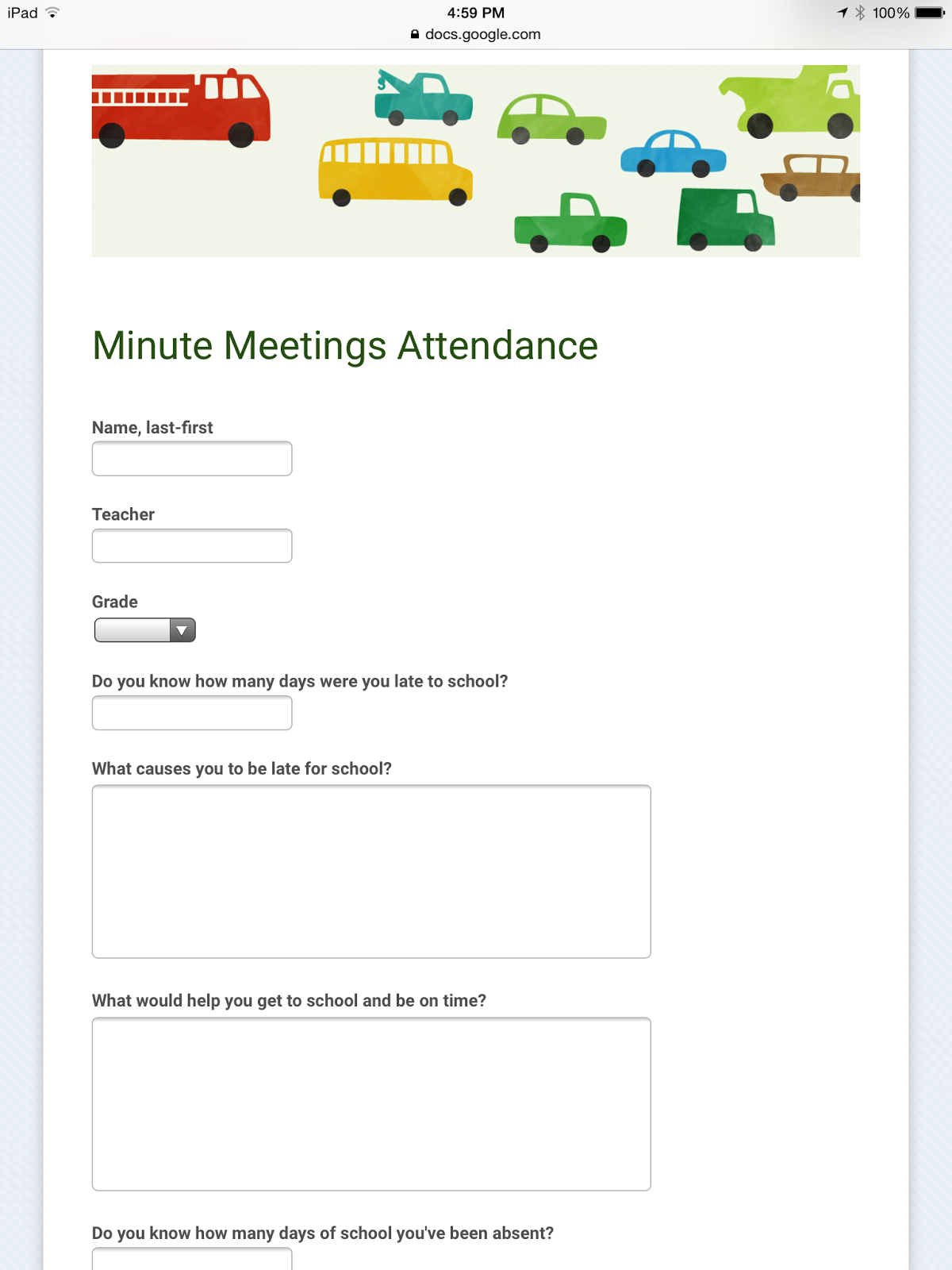
Minute Meetings, attendance
Minute Meetings, grades
Send your on-line counseling form link to your teachers and include instructions for adding it to their desk top so they can easily make referrals to you. Be sure to go under "Tools" on the Responses page and set "Notification Rules" so you are notified when a referral is submitted to your gmail.
I hope these forms are helpful to you for collecting data and documenting how you spend your time as a School Counselor. Are there other forms you would like to see? Do you have forms you have created? Please share your ideas!
Saturday, September 19, 2015
Creating a Counselor Activity Log with Google Forms
Google forms, round 2!
But now I am ready to try again. I have redesigned my form a bit, adding a drop down menu of teachers, grade level, reasons students may want to see me, and who referred them. Anything to make it click and go. I still have my notes section in case there is something I did not think of or that needs to be part of my record. Another great thing about Google forms is you can continue to edit them even after you have started collecting data. Click the black "edit this form" button at the top of the page of the "color" form and you will get the gray "editable version." Make your additions, deletions or corrections, close it up and continue collecting data. Need to edit a response? Click on the "edit form" button on the color form, go to the gray form and click on the "View Responses" tab. When it opens, scroll down to the entry you want to edit and make your needed changes. I will still keep a file on each student I see with more specific notes and memory aides. This form will allow me to track my daily time and whether it is spent on direct/indirect services and non-counselor related duties.
How's my progress?
Four weeks in and I am up-to-date on my daily entries! Looking at my data, already I see I am spending more time with classes than individuals, However, that is okay, as classroom lessons are a Tier 1 intervention where I lay the foundation of my program and skills training with ALL students. It is where I feel I get the biggest and best value for my time. With all my classes plus the individuals I am seeing, it comes out to more than 80% of my daily time is being spent in direct services to students and what could be better than that!
Truly, creating a shortcut on my desk top to my form has made a huge difference. It only takes a minute, literally, to click down the list of items on my form to record each activity. If you are interested in using Google forms, here is a link to my form to help get you started. You are welcome to make a copy and make edits that fit for you and your counseling program. I love Google forms and find them easy to create and edit. It is also easy to share data about your program and how your time is being spent (or encumbered!). Google forms also creates beautiful graphs. All you have to do is click on summary of responses to see its colorful creations.This is essential as we advocate for the best use of the School Counselor's time and also provides us with a valuable accountability piece.
Google forms step by step.
If you are new to Google forms, I am linking a PowerPoint presentation about some of their many uses and how to create your own forms. You will find slides 30, 31 and 32 especially helpful for taking a copy of my form and making it your own. Remember you must make a copy of my form before it will show up on your Google Drive. Otherwise, your data will be stored on my form, in my drive and you will not be able to access it. Also, anyone else who decides to edit my form will also be editing your form. And, I wouldn't want your hard work to go to waste!
Please feel free to contact me with questions or more ideas for forms. Good Luck with your forms! I think you're going to love them!
Friday, September 11, 2015
Free Bully Resource!!! Order yours today !!! Spread the Word!!!
Two years ago, Lizzie Sider, an energetic and talented young lady visited our school with her "Nobody Has the Power to Ruin Your Day" anti-bully assembly. For weeks prior to her visit we listened to her single, "Butterfly" so we would know all the words and could sing along when she arrived. My students made posters and butterfly decorations to hang in our cafetorium to greet her. She was an instant hit at our school with her beautiful spirit and singing voice. She shared her story of being bullied and how she has used music to help herself and others. Her kindness and compassion were genuine as she took the time to talk to each student, pose for photos, and give hugs. Lizzie is a teen-ager with a passion to be a singer and to share her anti-bully message with students everywhere.
Today I received the following email and just as Lizzie asked I am sharing this free resource with all of you. We would love to have Lizzie return, but since we can't this is the next best thing!
You’re gonna love what we are putting together for the kids and teachers this year.
Hi, Lizzie Sider here.
Over the last 2 years, I have been to more than 350 schools across America on my Nobody Has the Power to Ruin Your Day National Bully Prevention School Assembly Tour.
More than likely, I have been to your school or district, and now I respectfully request a BIG FAVOR.
Since I cannot get to enough schools, in person, we are creating a really great 30 minute bully prevention DVD that closely tracks the content of my live assembly. My goal is to get this no cost program into as many elementary and middle schools as we can.
Each school will receive the DVD, and a Booklet with discussion questions for the teachers to use back in the classrooms, as well as enough Nobody Has the Power to Ruin Your Day bracelets, for each student to receive one. All at no cost to the School. NO strings attached.
Please email me back to say “yes” that your school would like our no cost package. Please let me know how many students you have and your contact info and we will put your school on the list.
Shipping is anticipated to be mid to late October, 2015, but we will be in contact with you before that.
Help us get the Word Out, PLEASE!!!!
I am hoping you will forward this email, including the below video from me, to your associates and colleagues at other schools along with your personal recommendation.
Thanks so much for all that you do for our kids, and for your continued support.
Lizzie
The Lizzie Sider Bully Prevention Team
If you would like your school to receive this No Cost program, please respond with the name of your school, address, contact person and number of kids and email directly to:
Send all correspondence to: Lizzie@nobodyhasthepowertoruinyourday.org
Click here to visit my website: http://nobodyhasthepowertoruinyourday.org
Copyright © 2015 Nobody Has The Power To Ruin Your Day Inc., All rights reserved
http://nobodyhasthepowertoruinyourday.org
Copyright © 2015 Nobody Has The Power To Ruin Your Day Inc., All rights reserved.
Our mailing address is:
Nobody Has The Power To Ruin Your Day, Inc.
The Berkeley - Suite 200
6751 North Federal Highway
Boca Raton, FL 33487
Copyright © 2015 Nobody Has The Power To Ruin Your Day Inc., All rights reserved.
Our mailing address is:
Nobody Has The Power To Ruin Your Day, Inc.
The Berkeley - Suite 200
6751 North Federal Highway
Boca Raton, FL 33487
Subscribe to:
Posts (Atom)