Thursday, July 16, 2015

ASCA: My Conference Highlights, part 2

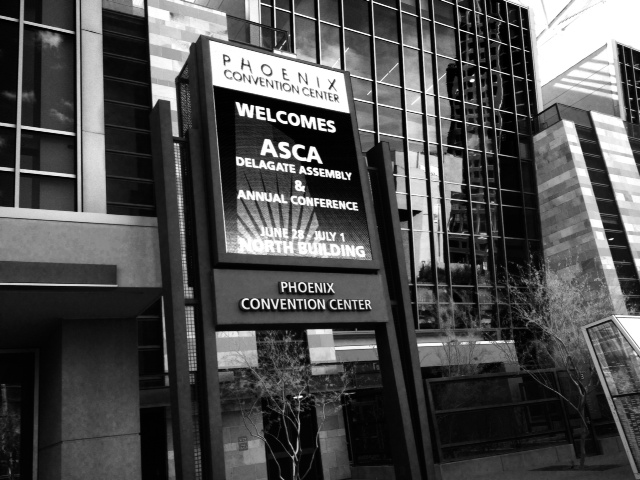
They need a spell checker in the sign department.

More ASCA goodness coming your way!

ASCA Day 2
Dr. Tim Shriver
Dr. Tim Shriver, Chairman of the Special Olympics was our speaker. He gave us the background on how the Special Olympics started and talked about his famous family, the Kennedys.  He told us how his Aunt Rosemary, born in 1918, had an intellectual disability and what it was like for families with a child like Rosemary during those years; locked away, denied an education, and forced sterilization.  Dr. Shriver talked about how his grandmother, Rose Kennedy, insisted that the other children include Rosemary in whatever they did. Whether a party, a dance, or getting together with friends, Rosemary was to be included. He talked about how he believed this impacted his uncle, President Kennedy.  In his now famous quote, "Ask not what your country can do for you, but what you can do for your country," Dr. Shriver says he believes President Kennedy was telling all Americans there are those around us who need our help. We need to ask ourselves how can we help them and each other.

As Dr. Shriver shared about the Special Olympics we heard moving stories of perseverance, saw statistics of monumental growth and heard how the Special Olympics is impacting children with disabilities around the world.  But still there is much work to do.  Dr.Shriver shared this powerful video with us during his presentation.  A young teen whose brother has an intellectual disability is taking a stand against the use of the  "R" word.


Dr. Shriver ended his speech by introducing a high school who participates in unified sports. This is where students with and without intellectual disabilities are combined in approximately equal numbers for training and competition.  These energetic students had us up and dancing.  What an inspiring group of young people!

Keller High School Athletes-Unified Sports 
The Special Olympics has a great website with a FREE  K-12 curriculum called Get Into it which celebrates the diverse gifts of every student whatever their ability. This website is an interactive web-based curriculum with fun, interactive, and creative activities, experiential role plays and engaging videos to help promote respect and acceptance among people with and without disabilities.
2000+ School Counselors #Reach Higher
More sessions, more learning!
My first session of the day was one I had been eagerly anticipating!  I heard Russell Sabella speak  at
ASCA last year and in the  fall at our state convention. His sessions were loaded with lots of great tech tips and I had no doubt he would deliver another information packed and thought provoking session. Russell Sabella and Madelyn Issacs did not disappoint!  Their session, Legal and Ethical Issues in School Counseling,was a fast paced session that was hard to keep up with at times, but what a lot they packed in 75 minutes!  The focus of this session was awareness and risks and how we can reduce the risks.  Madelyn Issacs started off by telling us, "If you are not getting training (in tech) all the time, you are hopelessly behind."  Wow!  She tells us tech is only a tool, people determine its function and value. Russ then tells us the value of these tools is how we use them. He reminds us that whenever we go on line we have power to impact how people view School Counselors, and we know the media is going after the weakest link!  "As people who are caretakers of children we are held to a higher standard.  If one of us is inappropriate it brings us all down."

Here are some great quotes/ideas from this session:
"Just because you can doesn't mean you should!"(even if it's legal and ethical)
 "Private ≠ Privacy, Privacy  Confidential"
We forget their are other audiences viewing our online content besides our intended audience.
When you post,  ask yourself, "Is there one person who shouldn't see this?"  Then don't post it!
"Facebook is not your therapist!"
"Post only things that are positive."
On "friending" students and parents...  Once again, just because you can, doesn't mean you should.

On using Skype, email and notes on Google Docs, be cautious about sharing information/private documents over non-HIPPA compliant protocols.  As for notes on Google  Docs, be certain  they do not contain any confidential information.  Be factual, be brief.  

Important to remember...
There was a ton of other information on HIPPA, FERPA and COPPA compliant sites and programs. We also learned about data encryption for our files, folders and hard drive, file shredding file wiping, and file transfers. I am hopelessly behind here and was a little overwhelmed by all the information and options. For more information about technology you can check out these websites by Russell Sabella.
SchoolCounselor.com, GuardingKids.com and My Data Boot Camp 2.0.


My next session was with Julia Taylor on Promoting Parental Involvement.  Julia reminds us to meet parents where they are.  Consider the things that may be barriers to them like time, personal history (how welcoming is your school), intimidation, school atmosphere ( hopeful? easy access?), child care, deportation, language, transportation, and divorce.  She says it is important for parents to know what we do without having to talk to us.  How do they know what we do?  Communication is key. It can be a website - post links to resources,  an e-newsletter like S'more, maybe Facebook, Twitter or Instagram. Provide information online, like a virtual AP fair they held for parents who can't always make it to school.  In this case, each AP teacher did a 3-5 minute talk about their course and work requirements. These video clips were recorded and put on a glog so parents could access them later at home.  Other great ideas included the app Remind, parent coffee club, book club, lunch and learn, parent needs assessment, parent education evenings once a quarter with a speaker like a banker to talk about how to pay for college or a police officer to talk about dating violence or social media.

The last session of the day was How to Create an iMovie with your iPad by Kelly Curtis.  She showed us lots of great examples of how they had used iMovie in promoting their PBIS program and other events around the school. These movies are posted on their school Facebook page and parents can see them and get a greater understanding of PBIS.  They also help connect parents with the school expectations.  Movies can be embedded in an e-newsletter like S'more as well so parents can see them.  Some video ideas Kelly shared were about the difference in tattling and telling, being an upstander, a day in the life of a ___grader to show the next grade coming up, playground expectations, and a teacher promo for a special school wide reward.  After some basic instructions about selecting a movie or trailer, dragging and dropping, panning photos and adding music we were turned lose to create our own video.  Here's my ASCA iMovie product!

Following a full day of sessions I met some of my new friends to try a nice pasta restaurant we heard about called The Strand.  It was quite good! The evening was filled with delicious pasta, relaxing conversation, and the sharing of experiences that comes from being School Counselors.
Oh so delish Lobster Mac and Cheese with Bacon!

From  left front to back: Lori, Jeannie, Valerie, Jan, Bridget, Susan, Carol, Jennifer,  and Grace
Photo by Grace's very charming husband
ASCA, the Last Day
The last day of ASCA 15 arrived far too quickly.  Just one last session and keynote Ted Federle remained.  I chose to attend Academic Support Groups by Karen Griffith, as one of my goals this next year is to address the 40% of 4th grades who are deficit in academic skills.  Karen had a ton of ideas that were new to me.  Like many of the previous presenters I had seen she was funny and went through her presentation with lightning speed.  Karen started off by telling us when doing groups be prepared. Well duh! But I know what she means.  There has been a time or two I came in and said, "Oh dear today is group.  What are we going to do today?"  The more you do ahead of time the less you have to do in the moment and the more present you can be with the children. So true and so obvious, but I hadn't really thought of it that way.  There are many people who can do group activities with students, BUT it is our EXPERTISE that makes the activity counseling. Karen also recommended against asking teachers what kids need which groups because she says we are asking teachers to do something beyond their skill set.  Hmmm. That is true.  I know when I have asked teachers in the past, some  will recommend the entire class or recommend kids for groups that are really not appropriate.  Karen says instead, ask teachers at grade level meetings who they are worried about and why, then you decide what kind of group is needed.  I like that.  I can get buy-in, but then I am free to make the best decision for students.

There were lots of great lesson ideas from her session, but no PowerPoint or handout to reference for later.  Sorry.  But it was a really good session, just wish there had been more take away resources.  Here are some high points and ideas from her session:
*academic skills are more than just study skills, it is also motivation and academic advising 
*There is no such thing as an "educational" emergency.  Your time with students should be protected, those "educational" emergencies can wait 30 minutes until you finish your group.
*6-8 sessions is not enough time for change to happen in groups, she recommends 12 sessions
* buy inexpensive clickers like used at big events to count the number of people entering a venue and give these to teachers trying to track how often a child off task/not working
*offer "On A Roll" ( say it fast it sounds like Honor Roll) guidance awards for students who bring up their grades, maybe not A's and B's but up from D or F each report card
* cool card sort activity- Using pictures from the internet, choose several dozen that show students showing varying degrees of studying to not studying.  Asks student to sort cards 5 most like you, 5 somewhat like you, and 5 not like you  OR choose 10 that show the different ways you are in class, put them in order OR put in order how you think the teacher sees your behavior/performance in class.

From Bullied To Broadway To Books
Broadway performer Tim Federle was our closing keynote speaker.  He says, "Everything that got me picked on as a kid gets me paid today."  He shares with us"7 things I learned on Broadway I wish I had known when I was a student."
1) Set backs now are the most interesting parts of your story.  Some call it character.  He says take control of your own narrative.
2) Perfectionism is way over rated. He shares a story of teaching adolescent boys to tap dance for the Broadway show Billy Elliot.  Those who came with grit exceeded those more naturally talent because they wanted it more.
3) There's no such thing as an anti-bully zone. We do our students a disservice if we tell them, or imply, once they graduate there is no more bullying.  Instead we must teach coping and resiliency.  It is important to help students realize the difference between what is a problem and what is an annoyance. Bullying doesn't stop, you just have to find your tribe.
4) Follow your whims as much as your dreams.  He tells the story of a single idea, he had a title for a book, Tequila Mockingbird. When he mentioned it to his publisher she didn't say no, she just said put it out there. That whim has sold over 100,000 copies.  Tim says our job is to say yes when no one else does.
5) Be nice to the guy who washes your socks.  When competing for a role in a Broadway show it came down to who fit in the costumes the best.  After receiving the call he got the role, Tim later found out he fit in the costumes the worst.  The head of wardrobe was someone he had known and befriended when he first started on Broadway.  That man stayed up all night altering the costumes for Tim.
6) Everyone is always starting over. In theater you are always looking for your next part of role. Just like in theater, we have to keep putting ourselves out there and taking chances. Life is a journey.
7) You never know when someone is going to change your life.  I had to leave to catch my plane as Tim begin to explain this, but I think I understand this one. I can think of situations in my own life when I met someone who I had no idea would later be a significant influence on me.  Or the time, hurtful as it was, when someone walked out of my life so someone better could walk in.  Or that person who shares a personal story or experience that totally changes your way of thinking from no way to I can do that.  You never know when someone is going to change your life.

RESOURCES
I would like to leave you with a few more resources before I close.  First ,there is a great new girls group book called Starbound by Carol Miller the founder of all those wonderful School Counselor Facebook pages.
Watch D.O.G.S.  (Dads of Great Students) an awesome program for getting Dads involved with their students and your school. It's not free, but something your PTA may want to get involved with.  And of course the previously mentioned free resources from Special Olympics, Get Into It,  helps build acceptance and respect and for persons with and without disabilities.


Well that's it for ASCA 2015.  If you were not able to attend, I hope you have enjoyed attending vicariously through these posts. I had a great experience and I'm looking forward to ASCA 2016 in New Orleans.  Until then, stay in touch through my Exploring School Counseling Facebook page, Twitter  @ExploringSchC and this blog.

Saturday, July 11, 2015

ASCA 2015: My Conference Highlights, part 1


What an amazing time I had at ASCA, meeting online friends in real life, networking, attending fabulous sessions, and hearing incredible keynote speakers!  It was a wonderful 4 days and for anyone who has not been to ASCA before, or it has been a long time since you last attended, start saving your money now for ASCA 16 in New Orleans July 9-12, “The Recipe for Success.”

ASCA Day–At-A-Glance
My ASCA 15 experience started on Saturday.  I arrived the evening before in order to attend the pre-conference RAMP camp session. That evening I was able to make a new friend from Colorado and meet up with some Twitter folks.  We went for dinner at a local Thai restaurant where we shared about ourselves and our schools and just enjoyed good food and good company.

Pre-conference sessions started first thing Sunday morning.  I signed up for RAMP camp and was so glad I did!  Last year when I first heard about RAMP camp I couldn’t imagine myself doing RAMP.  But this past year has been an amazing time of professional growth for me and I realize my school and I are ready to pursue the Recognized ASCA Model Program designation.  It’s all about using data to inform your goals and programming for your school and how to do it. I learned about School Counseling Advisory Councils, creating yearly, monthly and weekly calendars, and writing SMART goals (Specific, Measurable, Attainable, Realistic and Time bound).  We also covered action and results plans for class, group and closing the gap group lessons.  There were lots of great suggestions and tips and a presenter and RAMP reviewer who were happy to have us contact them as resources along the way as we pursue the RAMP process.

Building a Dream
Our first keynote was by Phoenix Science teacher, Fredi Lajvardi, from Carl Hayden Community High School whose undocumented HS students won the underwater robotics competition against colleges like MIT and Virginia Tech.  The movie “Spare Parts” is based on their story exploring their personal struggles and ultimate accomplishments.  Lajvardi tells us how the robotics club has grown and impacted the students at his school; the students no one expected anything from and who expected nothing of themselves.  He talked about breaking down barriers, shifting paradigms and embracing the diversity of your population in order to build success in your organization.  He tells us, “If life doesn’t give you a dream, build one.”  Check out this preview of "Spare Parts" below.  It is currently available on demand through AT&T U-verse. Be sure to watch!  What an inspiring story!


Ready to check out all the vendors and fill my treasure map!
Sunday evening the exhibit hall opened!  It is a School Counselors dream!  We had a Treasure Hunt card to take to various vendors to be stamped and later entered for several special drawings.  The vendors had the usual free stuff like pens, sticky notes, squishy balls, brochures, hand-outs and lots and lots of information.  Some great free websites I learned about you will want to check out are as follows:
www.startheregoplaces.com/why-accounting is a great career resource telling students about the world of accounting and the huge demand for accountants in every type of organization. There are videos and virtual field trips and a tab for educators with cool tools.

www.whatyouwant2be.org with lots of free resources and downloadable curriculum for middle and high school but I’m sure there are some things here I will be using with my 5th graders , especially about sexting. 

http://greatkindnesschallenge.org/   is a great website many of you probably already know about.  The Great Kindness Challenge  will be January 25-29, 2016.  Go to their website to register your school and download their kindness checklist and free toolkit.

www.careergirls.org   "Career Girls is a free, noncommercial, online platform which showcases video clips of diverse women role models sharing career and educational advice to inspire young girls to expand their horizons, improve their academic performance and dream big about their futures.  We are dedicated to providing girls of all income levels and ethnic backgrounds with the academic tools and support they need to achieve their professional aspirations.”  These awesome, high quality videos and lessons plans are mainly for middle and high school girls, however I can see using few of these with 5th grade and possibly some of my 4th grade girls.  

www.rightdecisionsrightnow.com  free evidenced based program whose goal is to teach tobacco prevention.  There are 3 instructional modules grades 5-6, grade 7, and grades 8-9.  Go online to order your free tools.

http://www.glsen.org/educate/resources/lesson-plans lots of free lessons plans and educators guides for lessons on diversity, bullying, and bias.  Check out information about no name calling week and the Ready, Set, Respect elementary tool kit to help all children feel safe and respected and to share those attitudes with others.

Monday Sessions at ASCA!
Let the learning begin! I have to be honest, it was tough to choose between so many great sessions!  There were always 3 or 4 or more sessions going on simultaneously that I wanted to attend.  ASCA did a superb job of gathering together an awesome selection of presentations.  

My first choice did not disappoint. I attended Technology Based College and Career Lessons by Rebecca Lallier and Amy Wheeler.  I knew this was the workshop for me when Rebecca told us ahead of time to bring our devices so we could create. Then when I heard her say, “This is not another fire hat, not another worksheet,”  I knew I was in the right place. Anyone can use her model to create units and not just about careers, but for any topic, at any level. 

Rebecca has created a website for her students called Career Smarts.  In her presentation she explained the methods and tools she used and showed us how to create something similar.  Using ASCA and Common Core standards Rebecca set up a digital platform, and curated resources like career videos, state colleges, information about multiple intelligence, and the Occupational Outlook Handbook.  She taught the lesson basics and then had the students explore and create their own knowledge. 

By creating the Career Smart site these ladies were able to engage students in all modalities, differentiate learning, give kids an innovative way to show their work, and build their tech skills. Students were also working on their reading, writing, collaboration, and organization skills, all while learning them about careers!  Sounds amazing doesn’t it?  Now before you get all excited and think this is a ready-made site you can use for your students, you need to understand this is closed site she created for her students with their work, so even in our ASCA session we could not view or access the entire site due to privacy.  The point of the session, to borrow from the proverb, was not to give us a fish, but to teach us to fish and Rebecca and Amy did just that.  They talked us through the entire process of  how they created  their site, gave us a list of awesome apps they used, talked about using various web tools,  curating videos and  web resources, and then gave us a chance to begin creating something of our own.  If you want to know more about “Career Smarts,” check out Rebecca’s blog at http://www.schoolcounselingbyheart.com/2013/07/20/creating-career-smarts/

In the afternoon I did a little session hopping as there was too, too much I wanted to see and hear.  I stopped in at the Amazing Data Race: An ASCA National Model Scavenger Hunt with Jeremy Goldman, which was quite good but I had just been to RAMP camps and he was talking about much of the same things we had just covered the day before.  So next I stopped in to see Dr. Carolyn Stone in her session on Critical Court Cases of the Last Decade.  As always she is funny and oh so smart and well versed in the court rulings that impact School Counselors.  When I arrived she was talking to a standing room only crowd about the Super Highway to Losing your Job.  And even though I had heard her speak at my state convention in the Fall I had to stop in for a few minutes and listen.  
I finally landed in 35 Creative Solution-Focused Strengths-Based Activities by Dr. Carol Buchholz Holland.  She was wonderful and there were actually 47 strategies.  I arrive at number 24 so I heard half of them.   Here are some of my favorites:
#30  Skeleton Key activity: help a student identify past successes, use and old key as an anchor for a student to keep in their pocket as a reminder of past successes.
#33  Power Hands activity: students draw and outline both hands (get a friend to help) write or draw on each finger things they are good at doing.  Spend time highlighting their strengths.
#36  Weathering Personal Challenge: divide paper in half and have student draw a difficult situation on the left side.  On the right side draw what got them through the tough time.  Have them caption how they made it through the tough time.
#38 Survive/Thrive Chart: have student think of a hard time, draw a T chart, label one side survive the other thrive.  Have the student list or draw what they did to survive the tough time. On the thrive side, ask the student to list or draw what they do to grow/thrive.  What has brought new meaning to their life?

My final session of the day was Games and Self-Assessments for Stress Management with Grace Wilhelm.  There was no PowerPoint in this room, just a rapid paced and humorous session with Grace demonstrating how she uses regular board games as tools for stress management with individual students, groups, classes, faculty, parents, and community members.  Games she uses frequently are Jenga, Don't Break the Ice, Kerplunk, Barrel of Monkeys, Topple, Spaghetti and Meatballs, Barking Bruno, and Connect 4. I especially loved how she used two of the games she shared with us, Jenga and Kerplunk.  

Grace uses Jenga as a meet the counselor activity.  For this lesson only, she asks the teacher to stay in the classroom with her to record the student responses. She numbers the Jenga blocks and calls out the numbers. As students come to the front of the room one at a time, they must say their name, where they live, who they live with and tell a story about a pet. All the while the teacher records this information.  Grace says this is a good opportunity for the teacher to get to know her students a little better too.  Once the Jenga tower is build she asks them to come up again and start taking the blocks out. She jokes with them that the longer this takes the longer they are out of math. Now  when they come up to remove a block they must say what they want to be when they grow up.  

Keplunk is used to talk about stress, but can also be used to talk about friendship or study skills or whatever you need it for.  In Keplunk, the marbles at the top of the container are the stress points,  the sticks in the middle of the container are the stress relievers. She asks what is something you can do to get rid of stress ?  As the student names something they pull out a stick.  Did that one thing release the stress? No.  What else is something you can do?  Pull out another stick, and continue to pull sticks for each stress reliever named by the student until the marbles are released. Did student get relief with one thing.  No there are lots of things you must do everyday to get rid of stress. Marbles can also be points to make an A. Sticks are what I need to do to get an A.  Marbles can represent friends.  Sticks can be all the things I can do to make friends.   To learn more about how Grace uses games and play check out her website at Counselor Games.

School Counselors After Hours  
The sessions are over for the day and so what's a School Counselor to do?  Now it's time to get out there and network with your follow School Counselors at the Meet-Up!  You know all those creative, helpful people you talk to on the Counselor Facebook pages and tweet with on Twitter chats?  Monday night was the time we all got to meet in person!  Carol Miller, our Facebook page founder, organized our gathering and created a fun Bingo game card for us to use as a way to mingle and meet each other. It was great to actually talk face to face with the people I have been chatting with online and some I haven't.  I even met some new School Counselor friends who are working overseas.  What interesting jobs and lives they have! As the Meet Up wound down, I headed out to dinner with some of my new friends and later joined them for Trivia night in the ballroom.  It was a full day and tomorrow promises more of the same.  Stay tuned for part 2 of my ASCA conference highlights.


The talented Traci Brown so nice to meet you!
Our awesome FB page creator and Meet-Up organizer Carol Miller.


New friend and fellow elementary counselor Kelly.


The "Meet-Up" Gang

Thursday, June 25, 2015

How LiveBinders Keep Me Sane and My Digital Resources Organized

I love the internet for resources of all kinds: class and group lessons, images, videos, music, PowerPoint and Prezis, activities, games, worksheets, Google forms, and more.  But sometimes it can be absolutely overwhelming!  I know you know what I'm talking about! I have seen dozens of the above items and think, "That is so cool! I want to try that," but then later, I can't locate it or remember what it was called or where I saw it.  I then waste untold time in a desperate search trying to find it again. Sometimes successfully, most of the time not. Or, I start clicking away to download things on my computer, only to have an enormous jumble of stuff in my download file that I find difficult, if not impossible to sort through.  So when I discovered LiveBinders, I knew that was for me!  What a great way to save my sanity and organize my digital resources!

LiveBinders is a FREE web-based service that allows you to create up to 10 digital binders with 2 levels of tabs and storage of 100 MB for storing, organizing, and sharing all your digital resources. Like a real paper and vinyl 3 ring binder, LiveBinders lets you create and organize your binders in whatever way that makes sense to you; binder by subject, tabs, subtabs, even color coded.  Tabs can be across the top of the page or on either side. As you explore LiveBinders, you might decide to have entirely separate binders for things like lessons, activities or videos. At this time, I have chosen to organize all my School Counseling resources alphabetically by subject area in one binder titled "All Things School Counseling."  You may also view my LiveBinder on the navigation bar at the top of my blog page.

In some ways LiveBinders is like Pinterest, as you can add a LiveBinders button to your tool bar and add items of interest to the tabs you have created in your binders, just as you do to your boards in Pinterest.  However, LiveBinders is a closed system and it will not suggest other "pins" for you or take you to similar binder resources. You may choose to make your binder public, keep it private, collaborate with others or share with select individuals by giving them an access key.

There are dozens of free, public binders you can view for ideas or to utilize their collection of resources. Some of those public LiveBinders include some pretty amazing School Counseling LiveBinders!  Unlike websites like Facebook, Pinterest, and some School Counseling blogs that are blocked by many school districts, LiveBinders (at this time) is still a web tool with resources I can access at my school.

There are numerous videos on YouTube and tutorials on the LiveBinders website to help you with set-up and organization of your binders along with other ideas for their use.  Check out this video for information on "How to Use LiveBinders in 7 Minutes."


In addition to cataloging your digital resources, LiveBinders can be used for organizing and sharing your lessons, collecting presentation resources, storing your School Counseling newsletters, even creating informational binders for parents.  Want to venture into the paperless domain? Maybe a "Back to School" LiveBinder for teachers or families with things School Counselor related like your introduction letter or PowerPoint, job description, services provided, curriculum plan for the year, special events announcements/calendar, School Counseling Advisory Council information, goals for the school year, data from the previous year, etc.  I am currently working on a Community Resources binder to share with the School Counselors in my district covering services available in our county and surrounding areas. The Community Resources binder will be a great tool for my local colleagues and I and an important addition to my school counseling website for parents. There are even step by step instructions to help with embedding a LiveBinder to your website on the LiveBinders "Help" page.

What can I say?  I love LiveBinders! When I'm surfing the web and I see an activity, lesson reosurce or article I like, I can just click on the LiveBinders button on my tool bar and it asks me which binder I want to put the resource in and which tab I want to put the resource under.  Click, click, click and your resource is saved.

The possibilities are endless for managing, organizing, and sharing your digital content as you surf the web and dream up ideas to improve your School Counseling program. So go to the LiveBinders website, set up your free account, add the LiveBinders button to your toolbar, set up some basic tabs by topic and start clicking. And the next time you are looking for that video or that activity sheet, you will be glad you did!

Saturday, June 20, 2015

Is Being in the Special Area Rotation Right for You?

Call me crazy, but I LOVE being in the Special Area rotation at my school!   Will this schedule work for everyone? No, it depends on the size of your school, your special area scheduling and resources.  Have you been asked to be in the Special Area Rotation?  Don't panic!  Read on about how I've made this decision work for me, the benefits I have experienced, and the questions you should consider if you think you might be interested in experiencing one of the most worthwhile things I have done in years!

How it Works on a Daily Basis

The first thing you must know is I am NOT in the schedule full-time.  I split a 6 class daily schedule with our Media Specialist and each of us does three classes a day. Each class is 45 minutes long so that comes out to only 2 hours and 15 minutes.  I still have 2 hours and 45 minutes to see students individually or in group and that takes into account I actually  take my ever elusive lunch and planning period of 30 minutes each.

Our special area schedule is divided into A week and B week.  On A week, I have the first 3 classes of the day (grades 2,1,and 4) and Media has the last 3 classes of the day (grades K,3,5).  That means I am finished with class by 11:00 and have the rest of the day for lunch groups, individuals or whatever I need. On B week I have the last 3 classes of the day and Media has the first 3 classes.  With this schedule I am free from 8:00 to 11:35 and have classes until the end of the day at 2:00. Teachers get a calendar labeling the weeks A and B to help them keep track. If a class falls on a holiday, or a class goes on a field trip the lesson is missed the same as if it were Art, Music, or PE.  When I have to be out, I get a half day sub and prepare a sub appropriate video with activity or coloring sheet for my classes. I am not comfortable leaving my regular lessons for a sub! I never miss an important meeting, conference, or professional development opportunity.


I have my own classroom which is wonderful and since teachers are not in the room for the lesson, I take the last few minutes of the class when the teacher comes to pick up the students to summarize the lesson, highlighting any important vocabulary or concepts I would like for them to reinforce.


Benefits
1) Scheduling!
Before being in the specials rotation, I had to chase down teachers to schedule my classroom lessons. What a frustration and a waste of time! In the days prior to high stakes testing, it was relatively easy to get in the classroom for lessons and pull students for groups at anytime.  In addition to high stakes testing, We have Common Core, and teacher evaluations based on student performance. This makes taking students out of class or scheduling classroom counseling lessons nearly impossible.  Teachers are extremely protective of all their instructional time and at my school they were all asking for the last 30 minutes on Friday for their lesson! You know how squirrely those lessons would be!  Being in the rotation gives me regular access to students and a ready made schedule.  No more chasing teachers to sign-up or walking into classes where the teacher says, "Oh, we have you today?  We were just headed out for recess," or "I forgot you were coming, we're taking a test."

2) Knowing All Your Students
I think this is the best part.  My school has about 580 students and I am able to get to know them ALL and they know me.  When I see students for individual counseling we have a frame of reference from classroom lessons that allows us to apply previously learned concepts and ideas.  Whether a small problem or crisis counseling, all students have a large "bank" of skills from which to draw from our work together in class.  They "get" what I am talking about and referencing from class lessons and activities.  This creates a more productive individual counseling time and reinforces the problem solving skills of students.

3) More Services, More Students, Less Time
This is another reason I love being in the specials schedule!  It is the best way to deliver the most services to the greatest number of students for the least amount of time.  In a comprehensive school counseling program ASCA states, "Every student gets everything." Classroom counseling is the most effective way to deliver those lessons deemed essential by your school data.  The ASCA recommendation of 80% direct/indirect services to students includes classroom counseling, but at no specified percentage.  My 15 classes a week only has me spending 56.2% of my time with my students.  I still have 43.8% of my day remaining in which to see groups and individuals.  By seeing all classes twice a month I am able to cover a wide range of topics from social skills to bullying to career education  to personal safety.  Not only does every student get everything, but I feel our regular lesson schedule gives my students the time to also explore and practice these skills.

4) Taking Classroom Lessons to a Deeper Level
The opportunity to really explore a topic with my students is another thing I especially love about being in the special area schedule!  Rather than 1 bully lesson and 1 RRW lesson in the fall, I was able to go much deeper. I did 4 lessons on bullying and cyberbullying and 3 lessons on healthy living and peer pressure. We were able to discuss topics and try activities I would never have had the opportunity to do otherwise.  Because of my regular classroom schedule I have been able to pilot 2 different Personal Safety curriculums in grades K-3 and dedicate 8 sessions to thoroughly training my student mediators. Before being in the special area schedule, lessons felt rushed and like I was only scratching the surface of a topic.  With more class lessons, I can take the time to engage students in meaningful conversation and role play rather than rushing to finish a topic in 30-40 minutes.  It's amazing the things students come up with and share when you have the luxury of time to allow them to explore a topic.

5) No Extra Duties!!!
No, maybe this is the BEST part!  Since I am part of the the special area schedule that rotates each week, it was impossible for my Principal to put me on any kind of cafeteria, playground, or testing duty.  She tried a few times then realized, "No, you can't do that you have class."  You know, I would do classsroom lessons anyway, but choosing to put those lessons in the specials schedule has eliminated my availability for non-counselor related duties. Awesome!!!

6) Administration Learns the Meaning of Emergencies
Prior to being in the special area rotation, I would often get called to the office to help with "emergencies."  Only about 99 times out of a 100 the calls were not counseling emergencies, but discipline cases that administration did not want to deal with.  I don't know about you, but I want to stay as far away from discipline as possible.  Yes, I am happy to follow up with a student after the referral and consequence phase to develop a plan for the future. However, I DO NOT want to be there when the student is "getting in trouble with administration." It is important for administration to understand real emergencies are those regarding potential threats of harm to self or others, a mental health crisis, abuse/neglect, or family traumas.

Counselor Concerns
1) Handling Real Counseling Emergencies
I know lots of School Counselors hate being in the specials rotation because they feel it prevents them from responding to a student crisis.  However, my question is what do you do now when you are in a class or a group and such a crisis comes up?  What happens then?  In my school, if it is a real counseling emergency, my administration will send someone to cover for me like the AP, media specialist, a teacher with an intern, or the academic coach.  Other situations that are serious but not of an urgent nature, were handled after class.

2) Managing Classroom Behavior
Some School Counselors have concerns about teachers being out of the room and having to manage the class.  This does not have to be an issue.  I have my own classroom, therefore I have my own expectations, rules, and procedures.  Even if you are going into a teacher's classroom, establishing your own behavioral expectations is important for good classroom management.  It is also a lot easier than trying to remember the different rules and procedures for 34 different classes. 

I have heard School Counselors express concerns about having to be a classroom disciplinarian and how it is contrary to being a School Counselor.  I agree, that is why I manage my classroom the same way I parent my children with love and specifically communicated expectations for behavior. We are a PBIS school and I teach and re-teach my students our school-wide behavioral expectations and what is expected in my classroom. Because I am constantly reinforcing Perform personal best, Act responsibility, Work and play safely and Show respect and reminding the students in a positive way what that looks and sounds like I have few behavior problems.  For more ideas about classroom management check out my post about Positive Behavior Cones, 3 Simple Ideas for Managing Classroom Behavior, the  PBIS website, CHAMPS  by Randy Sprick or Doug Lemov's book, Teach Like a Champion.

3) So Many Lessons, So Much Planning
First let me say, stay calm.  Don't try to plan a separate lesson for every single topic in every single grade level.That is a recipe for burn-out or insanity.  Plan two lessons, one primary, one intermediate for each topic. That's year one. You will get to do these lessons numerous times and really make them your own, figuring out what works and what doesn't at each grade level. In year 2, create two more for each topic, building on what you created the year before, doing the new lesson for everyone who previously heard year one's lessons.  In year 3, create two more lessons for each topic, again teaching it to those who have heard the previous lessons for year 1 and 2.  And now, you have a separate lesson for each grade level and quite possibly, your sanity as well.
Here is a link to a post about exploring free lesson resources on the web.

4) Teacher Does Not Hear the Lesson
In a perfect world teachers, parents, and administrators would all reinforce the fabulous lessons and concepts we teach.  However, I feel like these people are adults with relatively good life skills and they don't have to hear all the basic details of my lessons.  A nice summary at the end before returning the class to the teacher or an email or hand-out of lesson highlights is sufficient.  If it is a lesson that is being shared across the grade levels or school-wide, where you are introducing a new skill set or vocabulary to all the students, then sharing a 5 minute explanation at faculty meeting can be just as effective.

5) This is NOT Why I Became a School Counselor
Many School Counselors have stated "This is not why I became a Counselor." And I agree.  To a point.  ASCA tells us an important part of a comprehensive school counseling program is providing counseling for ALL students.  If I spend the majority of my time with individuals and small groups I am not providing a comprehensive program that meets the needs of ALL.  ASCA does not specify the percentage of time to spend in each of the direct services to students, but tells us that is to be determined by the School Counselor based on the needs of the school as indicated by the data and the school size.

Questions to Ask
Interested in being in the specials rotation but still not sure it is right for you? Here are some questions you should consider and discuss with your administration before deciding if this is something you would like to try at your school.

Do I enjoy sharing classroom counseling?
Do I have good classroom management skills?  
Do I have enough curriculum?  
Are there resources for purchasing curriculum?
Will I be allowed to choose my lesson topics and curriculum?
Do I have a bank of lessons from which to draw?
Will I have a classroom or be expected to travel from room to room?
If I am traveling will I always be allowed to access the technology in the classroom?
Will I be in the schedule half-day or all day?
Will I have input about what the schedule will look like?
What will our procedure be in the event of a student emergency?
What will happen with the special area schedule during state testing time?
What provisions will be made for the School Counselor absence in case of illness, workshop, or personal time?
What is the expectation for classes missed due to school holidays or school- wide events?
What if the arrangement isn't working? How long will we give it and how will we handle removing the School Counselor from the schedule?

Choosing to be in the special area rotation was a big decision for me and one I have not regretted.  It has allowed me to control my calendar, protected me from extraneous non-counselor duties, and has gotten me out of handling "student emergencies" that were really disciplinary situations and not a counseling crisis.  In many ways being in the special area schedule has simplified and enhanced my services to students and allowed me to provide a more comprehensive school counseling program.

I would be interested to hear your experiences about being in the special area rotation.  What benefits or issues have you seen?  Please feel free to post below or on the Exploring School Counseling Facebook page.


Saturday, June 13, 2015

Half-time Counselor, Full-time job!


For 5 years, at two different times in my School Counseling career, I was a half-time School Counselor split between two schools. It was challenging and at moments, many moments, difficult.  However, I learned a lot about myself, my insecurities, my ability to accept my limitations, how to delegate, and to get organized.  Two very different situations. However, organization was the common thread to keeping my sanity.

Situation #1   Half-time, 2 small schools, the ONLY School Counselor
For 2 years  I served two small schools that each had only a half time counselor, me. During those years, I chose a Monday/Wednesday, Tuesday/Thursday, every other Friday schedule due to the distance (almost an hour) between schools. Of course, when I was away from either school, I worried because I was the School Counseling program.

The first thing I learned, and had to accept, was I could not do a full-time School Counseling program at either school, no matter how badly I wanted it or how hard I was willing to work.  I was only at each school alternating 2 and 3 days a week.  I had to modify my expectations of what was realistic to accomplish for my own mental health.  I also learned there were other very caring teachers and staff who were already stepping in to help students and it was important for me to embrace that help and not feel threatened or defensive because someone else was doing a part of my job when I was not there.  I think that was the hardest thing for me.  I admit, I did not handle it well at first and got my feelings hurt.  But, when I took the time to reflect on the needs of my students and what was best for them, I realized it had to be about the kids, not about me. I made those ladies my closest friends at each of my schools and checked in with them weekly to keep up with what was happening with my neediest kids while I was away.  They weren't doing any counseling, but filling the gaps.  They did things like checking on pressure bandages for a burn victim, meeting with parents about attendance issues, and giving out information about community food sources.

During those years, I kept my program very basic, just seeing classes, groups, and individuals using the same lessons and materials at each school. Again, it was a sanity thing.  I would schedule a combination of no more than 4-5 classes and/or groups in a day.  That  still gave me time to see students individually.  I did no testing, no RTI, 504's, IEP meetings, or SST.  There was no time.  When I did do something special like Red Ribbon Week or Career Week, (more like half week) I did the same program and activities at both schools.  Both were done on a small scale just to give the staff and students a taste of each event.

Situation #2 Half-time, 2 large schools, the "Extra" School Counselor
Later in my career I worked for 3 years at two rather large elementary schools that were each pushing 1000 students.  Both had a full-time counselor.  I was the extra help. This time around my schools were close in proximity (15 minutes door to door) and I was able to split my day, mornings at one school and afternoons at the other. This was a far better situation because I knew when I was not there whatever was going on would be handled by the full-time counselor who was providing a full service School Counseling program.  The full-time School Counselors I worked with were the best, and I was never treated like the "extra help."  Together we worked out that I would take 2 entire grade levels at each school and all that entailed.  I took 4th and 5th grade at both schools (which made planning and lesson delivery a lot easier) and did all classes, groups, individual counseling, parent and attendance meetings for my students.  If a problem arose while I was away, the FT Counselor would handle it until my return.  Each morning I would check in with my partner at my morning school and each afternoon I would have lunch with my afternoon partner to check in on the students and situations there.  While at those schools I was not involved in any sort of duty, testing, SST, or IEP meetings.  I did do a few 504's, but not many.  Big school-wide events like Red Ribbon Week, Career Week, Family Fun Fair, and Parenting classes were planned together, but I was only given a small portion of the duties to help with implementation.  It was a successful collaboration and I enjoyed the opportunity to work with 2 different principals and faculties, and 2 incredibly amazing School Counselors.

Five Sanity Saving Suggestions
In both situations organization was key!!!  I was on the verge of losing my mind until I came up with the following guidelines for myself.  Hopefully these will help other split School Counselors.

1) Make a notebook.
I took a medium sized 3 ring binder and using my school's colors, I divided the binder between the 2 schools.  My morning school was in the front of the binder with the red dividers, my afternoon school in the back with blue dividers. Behind each divider I kept all the school schedules and calendars, special events, lunch, special area, recess, ESOL, Speech etc., for that school. I also kept faculty rosters, class rosters, parent contact information, and my group and lesson plan schedule. At my schools with a partner, I kept copy of her schedule as well.

In between the information for my two schools was a teacher lesson plan book I took apart, trimmed, and hole punched to go in my binder. The pages were printed front and back and the holes were punched on the right side of the  page. That way when I opened to a week I would see 2 pages and all that was happening in both schools at once.  The plan book was block style by hour with an entire day going across the 2 page spread. I liked the blocks because it gave me plenty of room to write. I have recreated a sample schedule and blank pages for reference.(These are best printed 2 sided.) The left side of the page was the morning school, and all the classes, groups, meetings, student and parent contacts I made for that school.  On the right side of the page was my afternoon school and my daily schedule for that day.  I also color coded my activities in highlighter for easier location and time tracking. Pink for parents, green for groups, yellow for classes, blue for individuals. This binder went with me wherever I went and kept me sane as I tried to juggle and schedule the needs of two separate schools.


2) Make duplicate copies of files and activities etc. for each school.  I can't tell you how many times, in the beginning, as a split School Counselor I would get ready to do something and realize it was at my other school!  Making 2 sets of files was time consuming, but saved me time and aggravation in the long run.  Books for which I only had one copy I placed in a crate which I kept in my car for easy access. One of those rolling carts would have been nice in my split Counselor days.


3) Keep your schools separate.
Only do the business for the school at which you are physically present. I know it's tempting to do a quick email or phone call. But don't.  Each school will want to claim your time as if they are your only school and you have nothing else to do. When at School A, give them 100% and address only their issues.  Same for School B. It truly does simplify things and ultimately, each school will appreciate your efforts to give them 100% of your time while you are there.

4) Don't play favorites.
I know this sounds silly, but I had people at both my schools that were forever trying to get me to say which school I liked better.  I was always very diplomatic and said something like, "You are both very special schools in your own way." or "Both schools have a lot of positives, I could never make that choice."  Teachers talk and word gets around. Even mentioning liking one thing about one school better than the other can damage your faculty relationships beyond repair. Just keep your thoughts on the subject to yourself.

5)Special Circumstances
Special occasions and events come up; so do emergencies.  Flexibility, planning ahead, and communication are crucial. There were times when I needed to be able to switch days between schools.  For example, my T/TH school had a longstanding May Day tradition that required I switch days with my M/W school to be there. I talked it over ahead of time with the administration of my M/W school and an arrangement was made.  One time I had an abuse disclosure that involved DCF and law enforcement and required I stay all day at School A.  I called School B and explained.  They understood and I agreed to make up that time by giving them an entire day the next opportunity in my schedule.  These things happened rarely,but communicating, planning ahead and discussing changes with administrations at both schools allowed me to be available for important school events and prevented any misunderstanding or hard feelings about scheduling and schedule changes.

Can a split School Counselor job work for you?  Absolutely! Stay organized, plan a realistic School Counseling program to match your time on campus, and communicate!
Are you a split School Counselor?  What strategies can you share that have worked for you ?


Saturday, May 30, 2015

7 Things "To Do" to Close Out Your School Year


My “get finished with school get started with summer to do list” is longer than my arm and I am not making much progress.  I'm procrastinating and writing this blog post to share some of the things I think are important for any School Counselor who is interested in building a data driven school counseling program to consider as she or he closes out their school year.

1)  Data Scavenger Hunt! 
I don’t know about your school district, but in mine they purge the system during the summer, making it impossible to retrieve data from the recently ended school year. So get out there and locate the data that is already being generated each and every day and is just sitting in your school district’s computer system waiting for you to find it.  This is the BASIC data School Counselors need to get and review BEFORE they begin to form any plans for the new school year.  This is the data that reveals your students’ needs and identifies where you should focus your efforts.  It is data you will use to compare the growth students have made because of the programming you have provided.  So find it!  Organize it! (I like a 3 ring binder) Disaggregate it!  SET GOALS!
Data to look for:
Attendance/tardy Reports
Reports listing students with D’s and F’s on their report cards
Reports listing students with poor conduct grades
Drop-out prevention/ at risk student listing, my district calls it the Early Warning System
School Climate Surveys
Discipline Referral Reports
Suspension Reports

Here are some editable colorful binder covers for your Data Notebook if you are interested in creating a one stop spot for all your data.

2)  Create a Curriculum Calendar
A curriculum calendar is a great tool to validate the importance of the School Counselor's role in providing services to ALL students to the administration and faculty of your school.  In her book The Use of Data in School Counseling, Trish Hatch says a well planned and filled out calendar supports and protects the School Counselor's time. "An open calendar lends itself to being filled with non-counseling responsibilities as it may appear there is nothing more valuable scheduled."

Based on the data you have analyzed, you now know the type of lessons needed school wide in your classroom counseling curriculum.  Some lessons will be specifically indicated by the data. Others will be presented because it is determined these are skills all students should know.  Create a calendar that shows core counseling lesson themes by grade level, ASCA Mindsets and Behaviors, curriculum, number of students to be served, and expected delivery dates.  Be sure to use the column on the right side of the form below to list yearly, quarterly, monthly and weekly events in which you are involved or responsible.  With this kind of planning Administration can see how data needs are being addressed by the School Counselor. Click HERE for a sample of my personal core counseling curriculum plan and HERE for a blank template.

3)  Be a Part of Planning Your School's Yearly Calendar
Don't wait until the start of the new school year to get your programming on your school's yearly calendar. It may too late by then.  Use your counseling core curriculum calendar and add your special events to your school’s year long calendar for the 2015-2016 school year now.  In addition to including special weeks, days, or activities you provide, sponsor, or participate in like Red Ribbon Week, Career Week, Holiday Food and Toy Drive, club meetings, Parent Nights, and puberty education, be sure to include your professional obligations.  It is important for PLC and district meetings, professional workshops and conferences, and School Leadership meetings to be noted on the calendar.

Annual planning helps you, and your administration, to see potential conflicts and gets your programs on the calendar early. This not only helps to avoid conflicts, but it gives you the luxury of planning your events when and where you want without having to settle, or make do, with left over dates and campus facilities.  Perhaps it will even give your administrator a chance to think about all you have planned for the coming school year. And maybe, over the summer, as they create duty schedules and consider non-counseling related activities, they will begin to understand the important work you do with students.

4)  Survey your teachers
This is not about what teachers think you should be teaching or doing, but a chance to get feed-back on the services you have offered this school year.  It’s about perceptions and it takes a thick skin to ask teachers what they think of your services, but sometimes that is an important reality check for some of us. It was for me last year and really helped me to be aware of some areas where I needed to step up my game. It even provided data on how well my faculty understood my job and where they needed more assistance from me in things like Problem Solving Team, 504 plans and reporting to Child Services.

 Here is a link to the Google form I created to survey my teachers last year.  If you would like to use my form, please remember to first make a copy and rename the form before using it or making any additions or deletions.  Otherwise your data will be co-mingled with mine and that will not help either of us.  For instructions on copying and renaming a form go HERE and scroll to slides 30 and 31.


5)  Establish an Annual Agreement
The ASCA website has a great template that lets has you establish the goals for your school counseling program and put them in a form, the Annual Agreement. This form is best completed after reviewing the data you’ve collected and is not only useful for showing your Administration the needs of the school as indicated by the data, but how you plan to spend your time to meet those needs. What a great proactive way to tie data and program needs to your skills as a School Counselor. For a copy of the Annual Agreement go HERE.

6)  Order supplies, books, or materials for next year
Now that you have set goals based on your data, it is easier to know what you are going to be teaching in classroom counseling and small groups.  Take inventory of your materials and decide what  you will need to successfully implement the program you have planned for your students.  Need new resources for teaching study skills, determining learning styles, or teaching conflict resolution skills?  Now is the time to get what you need and have the opportunity to familiarize yourself with your new resources.

7)  Stop procrastinating!
Clean up your office, file that mountain of papers, and go start some serious self care!  Enjoy your summer!  Do the things you love with the people you love.  Get some rest and renew you mind and spirit.  You deserve it!

Well that's it.  I've done the data scavenger hunt, created my curriculum calendar, and surveyed my teachers.  Next week when the students are gone I will be able order my materials and sit down with my Principal to work on our Annual Agreement and the School's Yearly Calendar.  And maybe, just maybe I will file the mountain of papers on my desk before I leave.

What's on your "to do" list?  I hope my list helps focus your ideas on how to begin to build a data-driven school counseling program in your school.

Have a wonderful SUMMER!